


 Cart
Cart
 sales@molnova.com


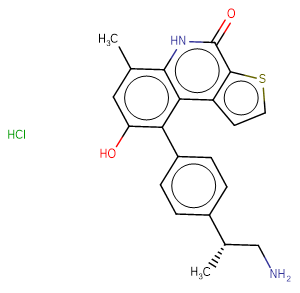
OTS514 hydrochloride
CAS No. ——
OTS514 hydrochloride( OTS-514 hydrochloride )
Catalog No. M19395 CAS No. ——
OTS514 is a highly effective TOPK(T-LAK cell-originated protein kinase) inhibitor (IC50: 2.6 nM).
Purity : >98% (HPLC)
 COA
Datasheet
HNMR
HPLC
MSDS
Handing Instructions
COA
Datasheet
HNMR
HPLC
MSDS
Handing Instructions
| Size | Price / USD | Stock | Quantity |
| 2MG | 111 | Get Quote |


|
| 5MG | 197 | Get Quote |
|
| 10MG | 354 | Get Quote |
|
| 25MG | 637 | Get Quote |
|
| 100MG | Get Quote | Get Quote |
|
| 200MG | Get Quote | Get Quote |
|
| 500MG | Get Quote | Get Quote |
|
| 1G | Get Quote | Get Quote |
|
Biological Information
-
Product NameOTS514 hydrochloride
-
NoteResearch use only, not for human use.
-
Brief DescriptionOTS514 is a highly effective TOPK(T-LAK cell-originated protein kinase) inhibitor (IC50: 2.6 nM).
-
DescriptionOTS514 is a highly effective TOPK(T-LAK cell-originated protein kinase) inhibitor (IC50: 2.6 nM).
-
In Vitro——
-
In Vivo——
-
SynonymsOTS-514 hydrochloride
-
PathwayOthers
-
TargetOther Targets
-
RecptorTOPK
-
Research AreaCancer
-
IndicationBreast Cancer
Chemical Information
-
CAS Number——
-
Formula Weight400.92
-
Molecular FormulaC21H20N2O2S.HCl
-
Purity>98% (HPLC)
-
SolubilityDMSO:10 mM
-
SMILESCl.C[C@@H](CN)c1ccc(cc1)-c1c(O)cc(C)c2[nH]c(=O)c3sccc3c12
-
Chemical Name——
Shipping & Storage Information
-
Storage(-20℃)
-
ShippingWith Ice Pack
-
Stability≥ 2 years
Reference
1.Kato T et al. Oncotarget. 2016 7(14):17652-64.
molnova catalog



related products
-
Histatin 5 (TFA)
Histatin 5 TFA inhibits the activity of the host matrix metalloproteinases MMP-2 and MMP-9 with IC50s of 0.57 and 0.25 μM, respectively.
-
steviolbioside
Steviolbioside is a natural sweetener it presents notable inhibition on human hepatocarcinoma cell Hep3B human breast cancer cell MDA-MB-231 and human pancreatic cancer cell BxPC-3 thus steviolbioside could be a potential remedy for human breast cancer.
-
FPR A14
FPR A14 is an agonist of formyl peptide receptor (FPR) and induces cell differentiation.
